Passion, enthusiasm and emotional intensity are genuine assets when it comes to rallying a team. But what happens when a leader swings suddenly from enthusiasm to frustration, or when their reactions become hard to predict?
In the Hogan Assessments model, the Excitable derailer brings this duality to light: an energy that is valuable for leadership but which, when poorly regulated, can weaken trust, cohesion and collective performance.
Understanding this dimension of personality helps leaders, HR directors and Talent Management professionals to spot risky behaviour more clearly, to build self-awareness and to turn emotional intensity into a lever for lasting leadership.
A newly appointed manager is brimming with excitement about working on a project alongside the team. Everything appears to be going smoothly. Then a minor obstacle comes up, and the manager suddenly erupts in frustration, raises their voice at colleagues and storms out of the room.
What just happened? The team is left bewildered.
A reaction of this kind can point to a leader whose emotional temperament sometimes gets the better of their ability to manage.
Some leaders have an intense, energetic personality that feeds their passion and their commitment to work. Yet when they let their emotions out without regulating them enough, their teams may come to see them as changeable, touchy or unpredictable.
In the Hogan Assessments model, this tendency towards emotional volatility goes by the name Excitable.
Such behaviour can make managing a team considerably harder. Understanding the strengths and risks that come with an Excitable profile is therefore an essential step towards leadership that is more aware, balanced and effective.
The three main Hogan personality inventories make it possible to assess personality strengths, behavioural derailers and individual values.
Derailers, also described as the "dark side" characteristics of personality, are measured with the Hogan Development Survey (HDS). They refer to behaviours that can become excessive in certain circumstances, in particular under stress, pressure, overconfidence or boredom.
The Excitable scale is one of the 11 derailment dimensions the HDS measures. It gauges the extent to which an intense, energetic personality may, in some situations, undermine performance at work.
Day to day, passion and energy can be real strengths. But once a person stops keeping an eye on their own behaviour, those very qualities can turn into outsized disappointment, an apparent lack of direction or emotional outbursts.
A leader who is keen one day and irritable the day after is thus likely to build up, little by little, a reputation for inconsistency and unpredictability.
Excitable leadership springs from one fundamental quality: passion.
Leaders who score high on this dimension are usually deeply invested in the people and projects that matter to them.
They often enjoy novelty and tend to work in bursts of energy, moving between spells of particularly intense commitment and moments when their motivation may dip.
A leader who is comfortable expressing a wide range of emotions can make an excellent counterpart to a colleague who is more reserved or less demonstrative.
Fiction often illustrates this complementarity, most famously through the pairing of Kirk and Spock in Star Trek: one expressive and passionate, the other more rational and measured.
Showing passion keeps a leader from coming across as cold, indifferent or uninterested.
Even so, emotional swings do not always serve the practice of leadership.
When stress amplifies emotions, leaders need to learn to adjust the way they voice negative feelings.
In a video devoted to this dimension of personality, Jessie McClure, who holds a master's degree and works as a senior consultant at Hogan Assessments, walks through the behaviours linked to the Excitable profile using a concrete example.
She also offers practical advice for keeping the expressions of this derailer in check and limiting their effect on performance at work.
This approach is a reminder that derailing behaviour is not inevitable. It can be identified, understood and gradually regulated through better self-knowledge and appropriate support.
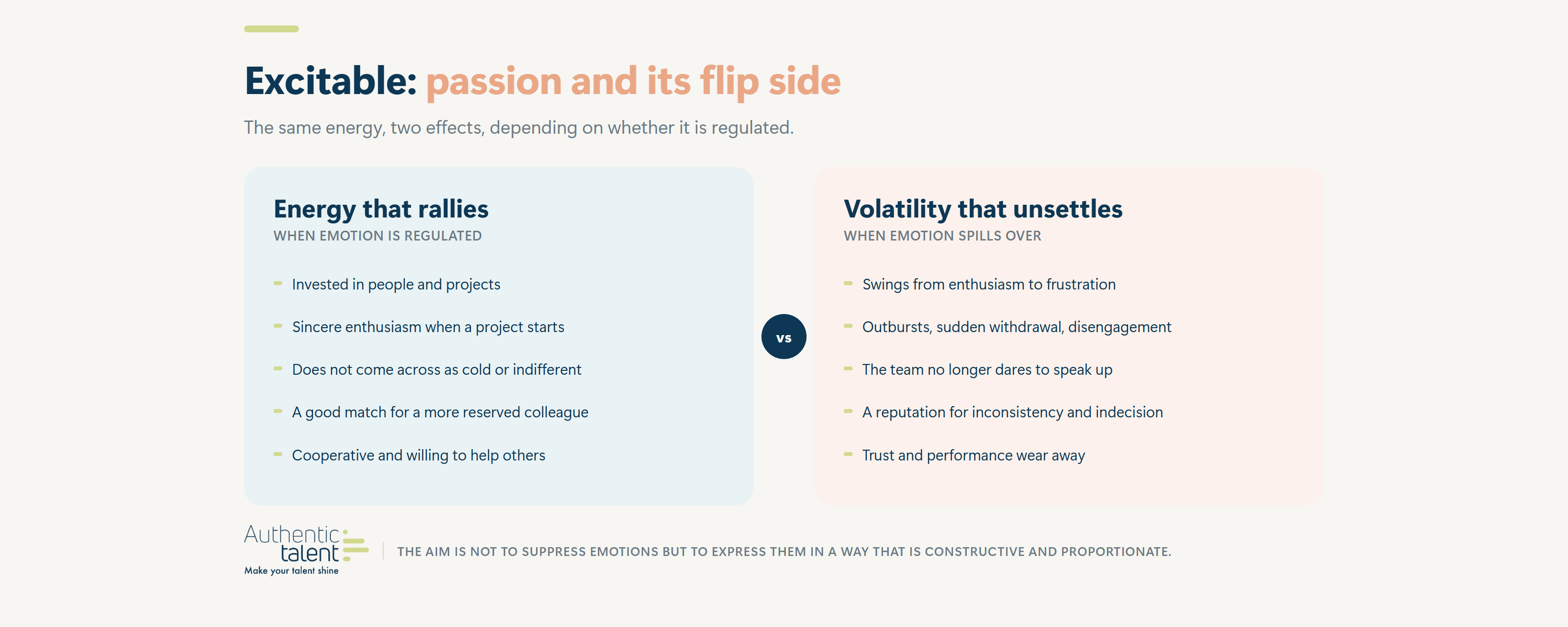
An overly reactive temperament can damage a leader's reputation and unsettle how the surrounding workplace functions.
A leader who shouts, expresses negative emotions inappropriately, suddenly withdraws or stops investing in certain tasks can put a serious brake on productivity.
In the most difficult cases, this behaviour can leave colleagues feeling uncertain, hurt or even afraid to speak up.
Leaders with a strong Excitable tendency can appear emotionally unstable, overreact or briefly lose control of their emotions.
They often show sincere enthusiasm at the outset of a project, yet can quickly become disappointed when things do not go to plan.
Although they are generally cooperative and willing to help others, they may give the impression of lacking direction or resilience.
The unpredictable nature of their reactions then breeds uncertainty about which way to go.
Over time, this pattern can help build a reputation for indecision and unreliability.
For a team, however, being able to anticipate how a manager will behave plays an important part in the quality of working relationships.
When people do not know how their leader will respond to a setback, it becomes harder to sustain a climate of trust and to encourage open discussion.
For leaders with a strong Excitable tendency, regulating emotion depends in large part on developing strategic self-awareness.
This skill means understanding one's own strengths and limits, but also realising how others see us, in other words, our reputation.
Strategic self-awareness enables leaders to change or rein in behaviours that do not always suit the professional setting.
For someone inclined to react strongly or to show marked shifts in mood, this may mean learning to keep the expression of their emotions within a range that those around them find more acceptable.
The aim, then, is not to suppress emotions but to build the capacity to express them in a way that is constructive and proportionate.
An Excitable leader should not try to give up their passion, energy or enthusiasm.
These traits are an essential part of the value they bring.
The real challenge is rather to keep their emotions from escalating to the point where they can no longer be controlled.
Fortunately, it is possible to learn to temper one's behaviour by gaining better command over how emotions are expressed.
The first step is to examine the situations in which frustration or annoyance arises.
Excitable leaders benefit from spotting the early warning signs and triggers that may herald a loss of emotional control.
Recognising them allows leaders to pause before reacting.
It also helps them step back far enough from the situation to avoid unintentionally sending negative signals that could affect their team's performance.
In the long run, high scorers on the Excitable derailer can steadily strengthen their resilience by learning to recognise how much stress they can sustainably cope with.
Faced with an exciting new project, these leaders do well to pair their natural energy with realistic expectations.
That balance helps them stay motivated when obstacles appear.
When problems or difficulties arise, they also need to commit to persevering.
By sticking to the plans and strategies already agreed, they help keep projects on track and strengthen their reputation as stable, dependable leaders.
The point is not to scale back their ambition or enthusiasm, but to make their commitment last.
Developing more emotionally stable leadership also depends on the quality of working relationships.
Excitable leaders can benefit in particular from having someone they trust who helps hold them accountable for their commitments and their behaviour.
Listening to input from reliable colleagues and staying open to what people around them observe is another valuable lever.
Finally, explaining to their teams the efforts they are making to change their behaviour can reinforce this developmental momentum.
These practices help leaders tell apart the situations in which expressing emotion is helpful from those in which it becomes excessive.
Gradually, they can learn to preserve their energy and passion while developing a steadier managerial stance.
The Excitable profile illustrates a fundamental truth about leadership: a personality strength can become a risk factor when it is expressed excessively or in a way that does not fit the context.
Passion, enthusiasm and emotional intensity can rally teams, stimulate engagement and help bring ambitious projects to fruition.
But when these qualities come with unpredictable reactions, poorly managed frustration or sudden disengagement, they can erode trust and jeopardise collective performance.
The goal is not to turn Excitable leaders into people devoid of emotion. It is to allow them to keep their intensity while building the behavioural stability that effective leadership requires.
Seen in this light, personality assessment using the Hogan inventories is a strategic lever for Talent Management and for developing leadership potential.
Combined with coaching and support, it helps identify the behaviours likely to surface under pressure, strengthen strategic self-awareness and support lasting change.
For organisations, investing in this detailed understanding of personality helps sustain a management culture built on trust, accountability and consistency.
For lasting leadership is not about feeling less intensely; it is about knowing how to turn one's emotions into constructive energy that serves the team and collective performance.
Jessie McClure holds a master's degree and is an industrial and organisational psychologist. She works as a senior consultant and team lead at Hogan Assessments.
The 11 derailers series: Excitable · Skeptical · Cautious · Reserved (coming soon) · Leisurely · Bold · Mischievous · Colorful · Imaginative · Diligent · Dutiful
At Authentic Talent, we believe that objective assessment of talent and potential within organisations is a decisive factor in their future success. If you would like to discuss it with us, let's talk!
This article draws on an article published on the Hogan Assessments website: Are You Too Temperamental? What Your Colleagues Won’t Tell You