

Why do some people hold such a clear view of their own strengths, while the colleagues around them see something quite different? The answer lies at the heart of a distinction that is central to personality assessment: the one that separates identity, how we see ourselves, from reputation, meaning how others actually see us.
That distinction matters for leadership, talent management and capability development. In working life, the decisions that count (hiring, promotion, performance reviews, the responsibilities someone is entrusted with) rest largely on reputation.
This article explains why self-knowledge cannot rely on our self-image alone, why personality data provides a more objective view, and how bringing identity and reputation into alignment supports leadership potential, performance and sustainable management.
Almost everyone recognises how much personality matters when it comes to telling people apart and forming a view of them.
When choosing a romantic partner, for instance, Hogan's research shows that 79% of men and 84% of women name personality as their main criterion.
But what exactly is personality?
At a fundamental level, it can be described as a person's underlying disposition, their core wiring, together with the thoughts, emotions and behaviours that flow from it.
Most of us are convinced we know our own personality very well. That conviction is only partly justified.
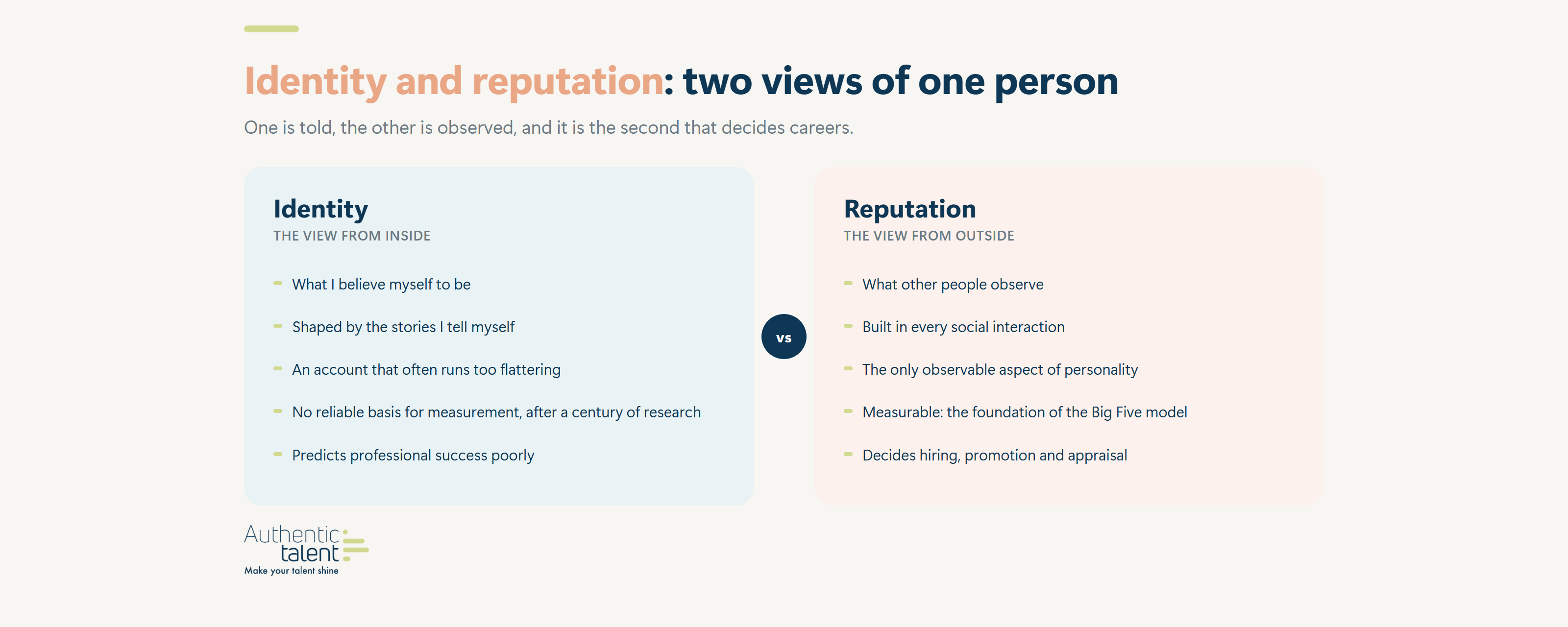
We are indeed the best experts on our personality when it is observed from the inside. That perspective is what we call identity.
Our identity is built through the stories we tell ourselves about ourselves. And as in any good story, we take a few liberties with reality. In the case of identity, the account we construct tends to be excessively flattering.
Other people have no access to that rather Pollyanna-ish version of our story. They encounter our personality from the outside, and in doing so they build the other major component of it: our reputation.
There is often a gap between identity and reputation.
We frequently misjudge ourselves. Some people are too hard on themselves, but in most cases we tend to overestimate our abilities relative to other people's.
We can therefore end up with an inaccurate picture of our own performance, whether that concerns interpersonal sensitivity, leadership skills, our ability to read others, our problem-solving, or even our sense of humour.
Without feedback on our reputation, the image we build of ourselves can easily drift into a fantasised view of our own talent.
The audition rounds of the television show American Idol offer a particularly telling illustration of the errors identity can produce.
Even without ever having watched the programme, we all recognise the scene, in fiction or in real life: a contestant steps in front of a panel and delivers either an outstanding performance that impresses everyone, or one that reveals a spectacular absence of talent.
Let us focus on the second case.
Some contestants give a poor audition and then react with astonishment, anger and disbelief when panel members such as Simon Cowell tell them bluntly that they cannot sing.
What makes these moments so fascinating is that many of these unskilled singers turn up at the audition genuinely convinced they are about to deliver one of the season's best performances.
These contestants are plainly focused on their identity to an extreme degree. They are then deeply shaken to discover that others do not perceive them in anything like the way they perceive themselves.
Fortunately, there is no need to expose oneself to humiliation on national television to understand the phenomenon. The extensive databases built from Hogan's personality research allow the importance of reputation to be studied far more objectively.
Hogan's data show that American Idol contestants are no exception.
A significant proportion of people approach their own careers in much the same way, giving disproportionate weight to their identity, that is, to how they see themselves.
Failing to understand one's reputation can have serious consequences, because professional success depends largely on what others think of us, while our identity has considerably less direct influence.
It matters relatively little whether you consider yourself perfectly suited to a role or an opportunity. The events that genuinely shape a career happen during social interaction, and interaction takes conscious effort.
In every exchange, we gain or lose a small share of status and social acceptance. We occasionally risk mild embarrassment and, more rarely, something a great deal more humiliating.
Our reputation is the cumulative result of all those interactions.
Reputation, meaning how others perceive you, influences whether or not you are hired for a given role.
Once you are in post, it also feeds into your performance review outcomes, your prospects for advancement, and many other decisions besides.
All day long, other people are forming judgements about you and acting on them.
Those judgements rest on your reputation, not on your identity.
Put differently: every important decision others make about you over the course of your life is based on the person they believe you to be, not the person you believe yourself to be.
This is a major consideration for talent management, leadership development and the way talent is supported. Understanding how someone is genuinely perceived takes you beyond their intentions and beyond their own account of themselves.
From a practical standpoint, reputation is also the only observable aspect of personality, and therefore the only one that can genuinely be measured.
This is one reason why contemporary approaches to the structure of personality rest on the Big Five model, which examines personality from the observer's point of view.
Identity, by contrast, has neither an equivalent measurement base nor a consistent measurement taxonomy, despite more than a century of discussion and research.
That does not mean identity is of no interest. On the contrary, it can be a very reliable way of predicting reputation.
Hogan's personality inventories are based on self-reported answers.
Yet even though Hogan asks participants questions that concern their identity, meaning how they describe themselves, the aim is not simply to tell them who they are.
After all, each of us already holds far more information about ourselves than anyone else does.
The value lies elsewhere.
From the way a person describes themselves, Hogan can indicate how others are likely to describe and perceive them.
It is precisely this move from identity to reputation that gives a rigorous assessment and development process its value. The aim is not only to strengthen self-knowledge, but to understand the real impact of one's behaviour on other people.
Ultimately, professional success depends largely on a person's ability to bring their identity into line with their reputation.
Conversely, professional difficulties tend to appear when someone's identity drifts a long way from their reputation.
Hogan supports individuals by giving them access to objective data about their reputation. That information offers a more realistic picture of how others are likely to perceive them, and allows them to adjust their behaviour accordingly.
When a contestant challenges the panel's verdict on American Idol, Simon Cowell has been known to reply: "Go to an audition where they lie to you."
In a sense, Hogan takes a comparable approach. Rather than confirming the image someone would like to hold of themselves, personality data offers a more objective view of how they are likely to be perceived.
For executives, HR teams and talent management professionals, the distinction between identity and reputation reaches well beyond simple self-knowledge.
It helps explain why certain managerial intentions fail to produce the expected effect, why some leaders over- or underestimate parts of their capability, and why objective feedback is such an essential lever for development.
A structured approach to personality assessment sets self-perception alongside likely professional reputation. Combined with coaching, it can help a leader or a team member identify which behaviours to strengthen, which to moderate and which to adapt to their environment.
That understanding is equally valuable for HR strategy, capability development, team transformation, and for building an organisational culture more conscious of the impact individual behaviour has.
Knowing yourself is essential. But in professional life, knowing how others perceive you matters every bit as much.
Identity is the story we construct about ourselves. Reputation reflects what others actually experience of our behaviour. When the two are aligned, people gain a far more realistic understanding of their impact and can act with sounder judgement.
This is the strategic value of a rigorous approach to personality assessment: turning perceptions that are often intuitive into information that can genuinely be used for development.
For organisations, that understanding supports a better-informed approach to talent management, leadership potential and team transformation. It makes it possible to develop people not only according to who they believe themselves to be, but according to the impact they actually have on those around them.
In the long run, this capacity to bring identity, reputation and behaviour closer together is a powerful lever for leadership, team development and sustainable organisational performance.
At Authentic Talent, we believe that objective assessment of talent and potential within organisations is a decisive factor in their future success. If you would like to discuss it with us, let's talk!
This article draws on an article published on the Hogan Assessments website: What Is Personality? Identity Versus Reputation


