

In times of crisis, leaders come under particularly heavy pressure. And certain personality characteristics that usually stay in check can then become more visible and shape decision-making, relationships with teams, or an organisation's capacity to adapt.
This second part of a study of more than 200 Colombian CEOs looks at personality derailers, the behaviours liable to surface under stress, fatigue or boredom. Through results from the Hogan Development Survey (HDS), the analysis brings out specific risks by sector: finance, industry, healthcare, services, technology, textiles, transport and tourism.
Understanding these tendencies lets leaders strengthen their self-awareness, improve their leadership and better anticipate the behaviours that could weaken their own performance or their teams'. A particularly strategic issue for personality assessment, talent management and the development of leadership potential.
Certain personality characteristics can pose a risk to a company's success. Hogan calls these characteristics derailers.
They tend to surface when people are stressed, tired or bored, in other words when their capacity for self-control drops.
These dimensions are among the hardest aspects of personality to manage, and can also be among the most damaging to a career.
Periods of crisis, such as the one analysed in this study, generate an almost permanent level of stress. These personality characteristics therefore become particularly important to observe and understand.
The Hogan Development Survey (HDS) measures eleven personality dimensions liable to become performance derailers in situations of heavy pressure.
Within the Leader in Times of Crisis programme, Thuoper, a strategic Hogan partner, teamed up with the Chamber of Commerce of Bogotá. Together they studied the personality characteristics of more than 200 CEOs in Colombia.
The programme set out chiefly to raise leaders' strategic self-awareness, to show them how a crisis is managed and to bring them out of it stronger.
As part of the programme, the CEOs completed the three Hogan personality inventories:
They then took part in a webinar hosted by Liliana López, CEO of Thuoper and an expert in organisational leadership, who presented the methodology along with the main personality characteristics for managing a crisis effectively.
Thuoper's Research and Development team then analysed the leaders' results across the various inventories. The analysis brought out significant patterns between their profiles and the economic sectors their companies operated in.
This second part of a three-article series looks more closely at the CEOs' results on the Hogan Development Survey.
In the financial sector, the main risk identified concerns behaviours associated with the Colorful scale.
People scoring high on this dimension can appear sociable, entertaining and playful. They generally enjoy being the centre of attention.
The major risk attached to this scale nonetheless lies in a tendency to overstate the facts and, in consequence, to create worry or even panic within teams.
In a sector as sensitive as finance, whose impact on society is considerable, this characteristic can obviously become particularly problematic.
Among CEOs in the industrial sector, two main risk factors were identified: Excitable and Reserved.
People scoring high on the Excitable scale generally work with passion and enthusiasm.
They can also become frustrated, irritated or upset quickly, though. They may then be tempted to abandon certain projects or withdraw their support from certain people.
The main risk rests on a difficulty in maintaining sufficient emotional control.
When events fail to unfold as planned, that reaction can damage working relationships, or leave projects, processes and ideas exposed.
An industrial CEO showing these characteristics strongly could therefore struggle to manage a crisis effectively and to keep leading their team in a way that rallies them.
People scoring high on the Reserved scale, for their part, can appear mentally tough, distant and relatively unconcerned with other people's emotions.
For leadership to be effective, regular communication with teams is essential, particularly in critical circumstances.
Under stress, however, leaders scoring high on this dimension may tend to reduce, or even cut off, that communication.
The results observed in healthcare proved particularly interesting.
Three main risk factors were identified: Bold, Mischievous and Diligent.
People scoring high on the Bold scale tend to appear confident, fearless and able to put themselves forward.
They can, however, find it hard to acknowledge their mistakes or to learn from experience.
This dimension obviously represents a particularly significant risk in healthcare.
The ability to draw lessons from experience and correct mistakes quickly is indispensable there. And to correct a mistake, you first have to be able to acknowledge it.
The Mischievous scale describes people who can appear brilliant, charming, adventurous, drawn to risk and inclined to test limits.
Seen from that angle, these characteristics can look positive in a sector under particularly heavy pressure.
The risk appears when limits are crossed and safety protocols or certain fundamental, non-negotiable principles get overlooked.
People scoring high on the Diligent scale, finally, generally appear hard-working, highly attentive to detail and driven by high performance standards, for themselves as much as for others.
As with the Mischievous scale, these characteristics can look positive at first sight.
The risk factor nonetheless shows up through certain "paralysis" behaviours.
Once the characteristic becomes excessive, the leader, or the team under their responsibility, may fail to produce the necessary results simply because those results do not yet match a standard considered ideal.
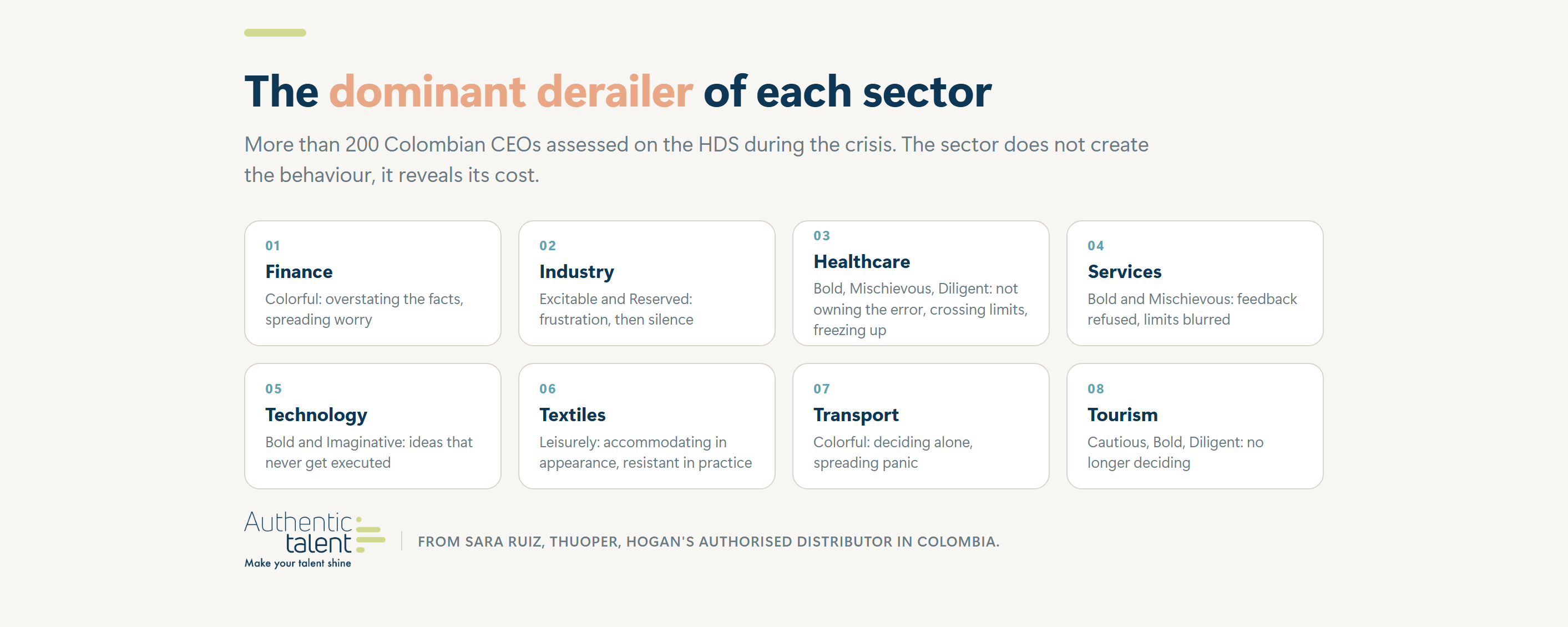
In services, CEOs again tended towards high scores on the Bold and Mischievous dimensions.
Difficulty accepting feedback or owning mistakes, associated with the Bold derailer, naturally represents a leadership risk.
Likewise, the possibility of pushing or blurring limits, in the broad sense, is one of the main risks attached to the Mischievous derailer.
Within sustainable management, the capacity to keep a realistic reading of one's own behaviour therefore becomes decisive.
CEOs in the technology sector tended to score high on the Bold and Imaginative scales.
As can be seen, arrogance can become one of the most common behaviours in certain people under stress.
The Imaginative scale describes people who can appear innovative, creative, sometimes eccentric and, in some cases, very focused on their own ideas.
The risk factor lies in particular in a difficulty turning ideas into reality or executing them, and in communicating pragmatically and in a way that is easy to follow.
In circumstances of crisis, a concrete, pragmatic approach matters especially.
Theorising, analysing, thinking and continually rethinking projects does not necessarily turn the few opportunities available into economic results.
For technology companies, the challenge is therefore to preserve creativity and innovation while strengthening the capacity to execute.
In the textile sector, the Leisurely scale is the main risk factor.
It describes people who can appear friendly and cooperative while in practice favouring their own priorities and resisting other people's, passively but persistently.
Genuine, open synergy is an indispensable condition for the survival of teams and companies.
Behaviours that consist of not cooperating openly while outwardly maintaining an accommodating manner can put that synergy at risk.
To sustain effective leadership, identifying and managing this kind of dynamic is therefore essential.
In the transport sector, behaviours associated with the Colorful scale also emerge as the main risk factor.
As in finance, a high score on this scale can become a double-edged sword.
These behaviours can lead to decisions taken too unilaterally, or generate needless worry and panic within teams.
In tourism, finally, three main derailers were identified: Cautious, Bold and Diligent.
The Cautious scale measures, among other things, risk aversion, fear of failure and a tendency to avoid criticism.
This dimension can become particularly hard to manage when it leads a leader to hesitate over a risky decision, or when they have to decide without holding all the necessary information.
And in new, uncertain conditions, taking decisions on incomplete information is practically part of daily life.
Leaders therefore have to balance caution against the capacity to act.
It is essential to remember that these behaviours appear mainly in certain circumstances, not least under the effect of stress, fatigue or boredom.
They do not, on their own, determine a person's leadership capability.
They can nonetheless have a significant negative influence on results, in human as well as financial terms.
This is exactly the value of an assessment and development approach: letting leaders understand the behaviours liable to emerge under pressure so as to anticipate and manage them better.
The third and final part of this series will look at these CEOs' motives and values.
Situations of crisis do not necessarily create new behaviours in leaders: what they mostly do is amplify tendencies already present in their personality.
This is why personality assessment plays a strategic part in talent management and leadership development. Identifying your derailers means understanding better how a leader risks being perceived under pressure, and also anticipating the potential consequences of their reactions for their people and their organisation.
Used within coaching and support, this knowledge becomes a genuine tool for skills development. It helps leaders strengthen their adaptability, improve their relationships with their teams and take more conscious decisions in periods of uncertainty.
For organisations, building this data into a broader HR strategy also strengthens leadership potential, supports team transformation and builds an organisational culture able to combine performance with resilience.
The point, then, is not to eliminate certain personality characteristics, but to learn to recognise the situations in which they can become counterproductive. That self-awareness is one of the foundations of sustainable leadership and enduring organisational performance.
This article was originally written by Sara Ruiz, head of the talent management model within the Research and Development team at THUOPER, Hogan's authorised distributor in Colombia.
At Authentic Talent, we believe that objective assessment of talent and potential within organisations is a decisive factor in their future success. If you would like to discuss it with us, let's talk!
This article draws on an article published on the Hogan Assessments website: CEOs in Crisis: The Influence of Leaders' Performance Risks (Part 2)


